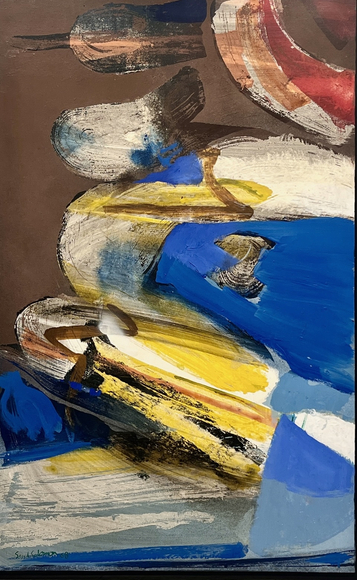
SYD SOLOMON
Trisola, 1968
Oil and Acrylic on cradled wood panel
48 x 30 inches
Titled and dated verso
Syd Solomon (1917 – January 28, 2004) was an influential American abstract artist. He spent most of his time in his homes in both the East Hamptons and Sarasota, Florida which influenced many of his paintings. His works have been featured at The Guggenheim, The Whitney, Corcoran Gallery of Art, The Wadsworth Athenaeum and several others.
Solomon’s early life was spent growing up in Pennsylvania where he got his start painting in high school. Later he went on to study at the Art Institute of Chicago from 1935 to 1938. In 1940 he enlisted in the Engineer Aviation Regiment, First Camouflage Battalion of the military. During this time Solomon helped design camouflage for the California coast near the San Francisco area. Later he was assigned to the Royal Engineer Camouflage Corps in London where he designed camouflage to be used against the Germans in World War II. He even went on to earn the Bronze star for his contributions during the Battle of the Bulge. During his time in London he mostly performed aerial reconnaissance which inspired his ideas of abstract art. After leaving the military he went on to attend classes at the French art school L’Ecole des Beaux-Arts in 1945.
Solomon and his wife Annie moved to Sarasota, Florida in 1946. After the 1950s Solomon’s style became heavily influenced by nature. His works illustrate his fascination with the climatic and overall environmental conditions of land, sea, and sky. In the 1960s he started using polymer tempera as a base and would then combine it with various colored inks and oils. Syd was also was one of the premier artist to use acrylic paint. He became a fan of a specific resist technique that used a lactic caseing solution to mask the painting. His painting gestures usually consisted of circles, squares, and curves. Solomon was not concerned with perfection in his art strokes as much as rough edges that left for unpredictability. Although he used a range of colors in his paintings, the color black has always played a big part in his work.
Solomon was included in several national exhibitions throughout the 1950s. In 1955 the couple first visited the East Hamptons of New York which soon after became their second home. By 1959 the Solomons had developed the ritual of spending winter and spring in Sarasota and then fall in the Hamptons. Solomon continued this dual lifestyle for over the next 30 years. The environmental settings of his two homes worked as inspiration in his paintings. By this point the Solomon family had also grown to include a son Michael, and a daughter Michelle. By 1959 the artist had began regular showings in New York at the Saidenberg Gallery while also doing shows in both the Hamptons and in Miami.
In the 1960's Solomon’s reputation reached a high point and he was being shown at many of the finest museums in the world. In 1961 he received several awards and accolades including the 13th New England Annual and the Painting of the Year from the Whitney Museum of American Art. This popularity made him an influential personality in both his Hamptons and Sarasota communities. He helped bring many well established artist down to Florida such as James Brooks, Larry Rivers, and Conrad Marca-Rell after he started his Institute of Fine Art at New College. The Solomon home in the Hamptons had also became a sort of cultural gathering spot for many famous artist and writers.